26 rules behind the decision to buy
People decide to buy not when they are convinced, but when they want it. Logic arrives later, to justify the choice. Here are 26 rules behind that moment — not pressure tactics, but how the decision actually works. Grouped into five blocks you can read one at a time.
One caveat up front: this is not about making anyone buy. Emotion opens the door, but if there is no value behind it, the person returns the product and writes a review. These rules only work on an honest product.
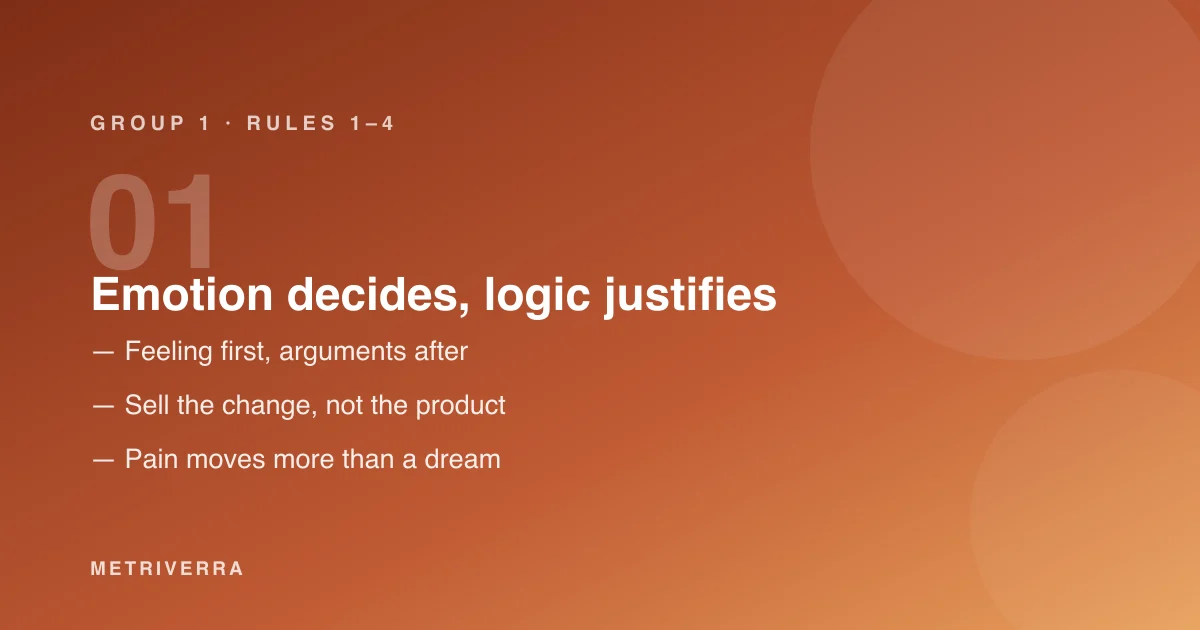
Group 1. Emotion decides, logic justifies
1. Feeling first, arguments after. Most buying decisions are emotional, and logic follows to explain the choice to yourself and others. That is why specifications convince no one who doesn't want the thing yet.
2. Sell the change, not the product. People pay for the outcome and the life it enables, not for the object. "Cream with hyaluronic acid" and "skin that doesn't feel tight by evening" describe the same thing and work very differently.
3. Pain moves more than a dream. Avoiding a problem motivates more often than gaining something new. Start with what will stop happening, then say what will appear.
4. Marketing without psychology fails. Understanding how people think gives a campaign a chance that neither budget nor tooling can buy. It is not magic — it is knowing the order: attention, then desire, then justification.
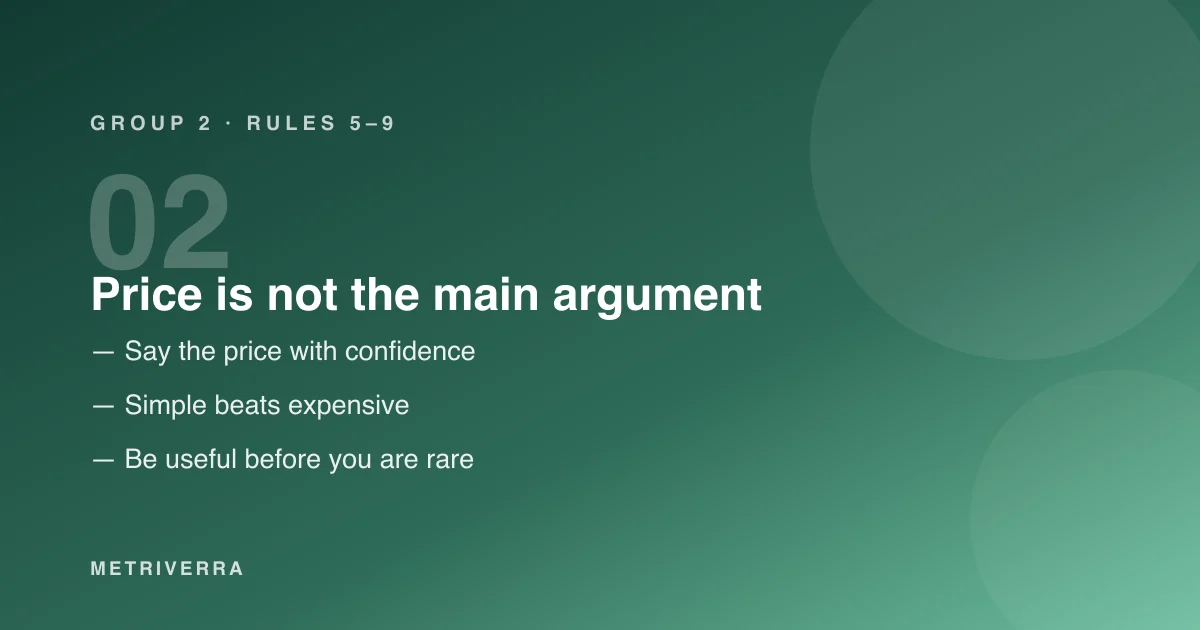
Group 2. Price is not the main argument
5. Say the price with confidence. State it plainly and give the person time to think instead of pushing. Hesitation in the seller reads as hesitation about the product.
6. When the benefit is visible, price fades. An argument about price almost always means the value wasn't explained. That is a reason to rewrite the explanation, not to discount.
7. A crowded market is not a verdict. More often it is the message that fails, not the market: it doesn't resonate with the audience it targets. Competition proves demand exists.
8. Focus beats the toolbox. The ability to stay focused matters more than the newest software. Five clear messages beat forty channels nobody has figured out.
9. Be valuable before you are rare. Scarcity works only when there is usefulness. Restricting access to something nobody wants creates no demand.
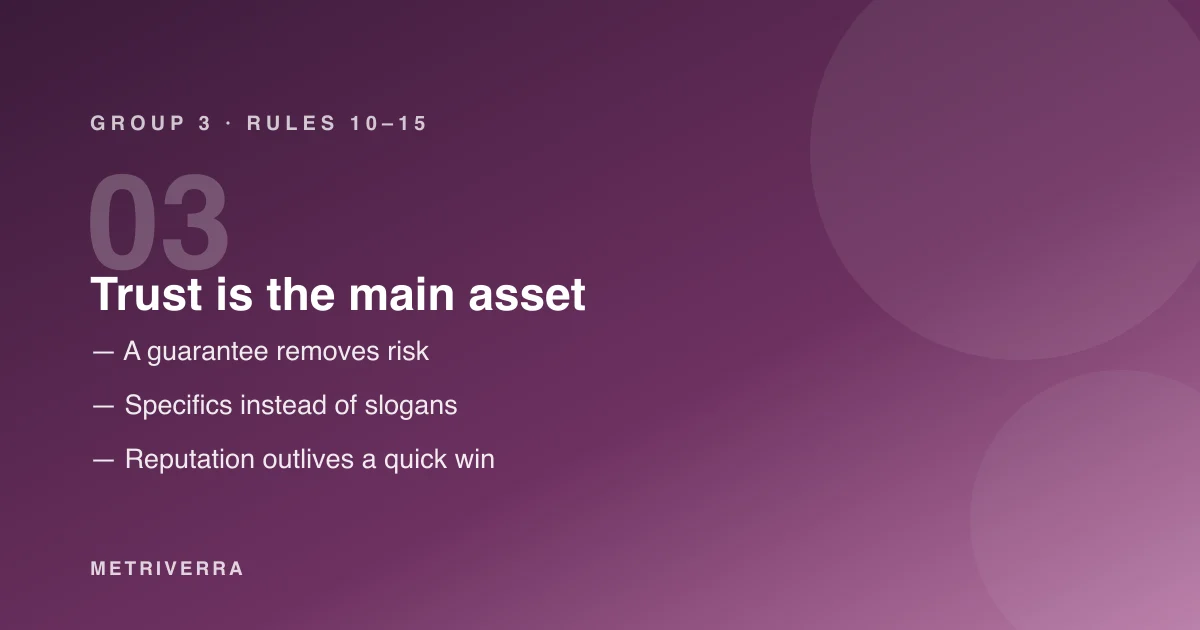
Group 3. Trust is the main asset
10. A guarantee costs less than a discount. A clear promise to refund or redo removes the fear of making a mistake — and that fear is what stops people most often.
11. Real reviews beat polished ones. Genuine client stories with names and faces make a business credible. Flawless anonymous testimonials read as invented and work against you.
12. Be specific. A detailed, exact message earns more trust than a beautiful vague one. "Delivered in 2 days across Ukraine" beats "fast delivery".
13. Loyal clients pay more than the hunt for new ones. Long relationships bring revenue that chasing first orders never will — and they cost less.
14. Don't trade reputation for a quick win. A short-term gain taken out of trust always turns out more expensive than it looked. What took years to earn is lost in one move.
15. A story closes the distance faster than facts. Stories are remembered far longer than features and figures. People retell stories; nobody retells a spec sheet.

Group 4. Attention and words
16. Curiosity in the first seconds. A strong opening holds people and makes them read on. If your first line explains who you are, the attention is already gone.
17. Take the words from clients, not from your head. The best marketing speaks to real needs because it is built on what people actually say. Write in their words, not yours.
18. Go where people are already looking. Instead of pushing interest, stand where the interest already is. Creating demand is expensive; answering it is not.
19. People buy the result, not the mechanism. What matters is how the product changes their life, not what it is. A feature list answers a question nobody asked.
20. A question works better than a pitch. The best sales conversations start by understanding what the person needs. While you're talking, you're learning nothing.
21. The client is the hero, not you. Frame everything around them and the result they want. Your role is the guide, not the main character.
22. Marketing amplifies a product; it doesn't replace one. Even an excellent product needs a convincing message to be noticed. And no message saves a product that doesn't solve the problem.

Group 5. An offer hard to refuse
23. Market beats offer. A weak market is not cured by a good offer. Choose a market with real demand first, then sharpen the offer.
24. Answer objections in advance. Address the common questions before they are asked: that reduces doubt while the person is still listening.
25. Four supports of a strong offer. The strongest offers lower risk and raise perceived value at the same time. Each device alone is weaker than all four together.
26. Design is part of the argument. Professional design attracts attention, builds trust and makes the message more persuasive. A careless image cancels out good copy.
Frequently asked questions
Is this manipulation? No. Manipulation is when the promise doesn't match the product. These rules describe the order in which a decision is made and help explain real value more clearly.
Where do I start if there are so many rules? With the first group. Rewrite the first screen so it speaks about the outcome rather than the mechanism — that changes more than the other twenty-five rules combined.
Does this work in B2B? Yes, only the emotion is different: not delight but the fear of being wrong in front of a manager. Guarantees, reviews and specifics count for even more in B2B.
What if the client argues about price? Don't discount straight away. A price argument almost always means the value wasn't explained: rewrite the explanation first, then talk about a discount.
How do I know a rule worked? By one number: the share of people who reach the next step. Not by revenue — it grows with traffic and hides the truth.
In short
- The decision is made by emotion; logic is there to justify it.
- An argument about price is almost always a sign of unexplained value.
- Trust is built with specifics and real stories — and spent in an instant.
- Attention is held by curiosity, and copy is written in the client's words.
- A strong offer is proof, urgency, a bonus and a guarantee together.
The rules come from practice and from classic work on buyer behaviour: A. Damasio, «Descartes' Error» (1994) on the role of emotion in deciding; D. Kahneman, A. Tversky, «Prospect Theory», Econometrica (1979) on why a loss weighs more than a gain; R. Cialdini, «Influence» (1984) on trust, proof and scarcity.